 Portugal
 Antigua & Barbuda
 St Lucia
 Grenada
 St Kitts
 Dominica
 Hungary
 Malta
Malta Greece
 Italy
Italy Latvia
 Turkey
 Vanuatu
 Canada
 USA
USA Nauru
Nauru New Zealand
 Panama
 Cyprus
 Sao Tome
 UAE
UAE
St Kitts
Minimum $250,000 Donation
Real Estate Option
Citizenship & Passport
Long Established Program

7 September 2026
A growing share of our enquiries now comes from people whose home moves with them. Some own a boat and spend half the year crossing between the Caribbean and the Mediterranean. Others fly for a living, or own the aircraft they fly, and treat airports the way most people treat their local station. They aren’t relocating in the traditional sense, because there’s nothing to relocate. What they want is a passport and a residency base that keeps up with the way they already live.
We’ve started calling this group the nautical nomads, and the pilots who sit alongside them. They arrive with a different set of questions from our usual clients. Nobody’s asking about international schools or which suburb to buy in. They want to know which flag suits the boat, which passport smooths the next port of entry, and which program won’t tie them to a country they’ll only see for a few weeks a year.
Life at sea sounds free until you look at the paperwork. Cruising permits, crew visas, customs clearance and insurance all key off nationality, and a weaker passport turns every new jurisdiction into an admin project. Owners who cruise widely find that the same itinerary costs one crew member three days at a consulate and another nothing at all.
Aviation runs on the same logic. Pilots and aircraft owners deal with layovers, positioning flights, diversions and short-notice schedule changes, and every one of those can involve a border. A second citizenship with broad visa-free access takes a whole category of problems off the table. It also gives crew and family the option of moving quickly if a schedule or a situation changes.
There’s a second reason, and our clients raise it more often than they used to. People who live between jurisdictions want somewhere that is genuinely theirs on paper. A second citizenship gives them a legal base that doesn’t depend on a visa, a work contract or a marina berth.
For anyone who sails the Atlantic circuit, the Eastern Caribbean isn’t a detour. It’s the winter season. That makes the region’s citizenship by investment programs unusually practical, because the physical presence requirements line up with where the boat already is.
The main options work like this:
All four grant citizenship directly rather than through a residency period, so there’s no requirement to move, and no clock to run down before a passport arrives.
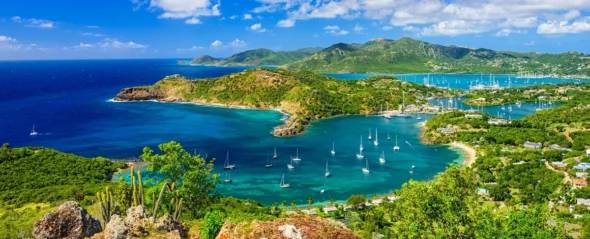
Antigua is the one our yacht-owning clients ask about first, and it’s easy to see why. The country has built its identity around sailing, and the season brings owners, captains and crew back to the same harbours year after year.
The program offers several routes. A contribution to the National Development Fund starts at US$230,000 for a family of up to four. Approved real estate starts at US$300,000, held for five years, which appeals to owners who want a base on the island rather than a donation. There’s also a University of the West Indies Fund option at US$260,000 for larger families of six or more, and a business investment route from US$1.5 million.
The Antigua marina villas sit within the island’s largest marina development, and they give investors the chance to own a luxury villa in a secure coastal community. The surrounding infrastructure covers restaurants, retail, golf and beach access, so the lifestyle is there whether you’re aboard or ashore, and the villas carry strong potential for rental income and long-term value between visits.
For an owner who already brings the boat to Antigua each season, qualifying for citizenship through a property a short walk from the berth is about as neat a fit as this industry offers.
The physical presence requirement is the part worth understanding properly. Antigua has historically asked new citizens for five days in the country during the first five years, and it is now moving to 30 days under the 2026 amendments that bring the program into line with the new regional regulator. Those 30 days are cumulative across the whole five-year period, not annual.
For a client sitting in Falmouth Harbour every February, that requirement is met without changing a single plan. For someone who has never been near the Caribbean, it’s a genuine commitment. It’s one of the clearest examples we see of a program suiting one kind of client far better than another.
The passport gives visa-free or visa-on-arrival access to more than 150 destinations, including the Schengen Area and the UK, and citizenship passes to future generations. Antigua and Barbuda also charges no tax on worldwide income, capital gains or inheritance.
The pilot enquiries follow a similar shape but come from a different place. Many are commercial pilots based in the Gulf or Asia, flying under one nationality, living under another and holding assets in a third. Others own aircraft and want the flexibility to fly where they choose without their nationality dictating the route.
For this group, residency programs often do more work than citizenship. The UAE’s ten-year residency, available through property investment from AED 2 million, suits crew already based in Dubai and offers a tax position that fits a mobile career.
Portugal’s Golden Visa asks for an average of seven days a year in the country, which is realistic on almost any roster, gives permanent residence at five years and makes it possible to apply for citizenship after ten.
Greece’s Golden Visa runs at three tiers, at €250,000 for qualifying conversion and restoration projects, €400,000 across most of the country and €800,000 in Athens, Thessaloniki and the larger islands, with no minimum stay at all.
The common thread is that none of these programs demand you stop moving. That’s the whole point.
The same owners who winter in the Caribbean still need somewhere for the boat, and themselves, once the season turns north. Malta’s Permanent Residence Program gives residency in a country that is also one of the world’s leading flag states for yacht registration, which matters when the boat and the owner want the same jurisdiction behind them.
Crete goes a step further. An exciting new beachfront resort currently under construction is being built around what will become Greece’s largest private marina, managed by Camper & Nicholsons.
Most residency-by-investment property is a qualifying asset first and a lifestyle second. Here the berth, the residence and the permit come from the same place, on a coastline that already anchors the eastern Mediterranean season.
The wider resort covers hotel and branded residences, restaurants, retail and beach facilities, so the property works as a rental asset in the months you’re elsewhere.
Greece and Portugal both offer routes that combine a cruising ground with a residency permit and, in time, the possibility of an EU passport.
Put the two halves together and the pattern our clients follow becomes obvious. A Caribbean citizenship for the winter, a European residency for the summer, and neither one asking them to be somewhere they wouldn’t already be.
For a personalised consultation, get in touch with La Vida’s experts to talk through which programs fit around your global needs.

Spears Interview | Brits Consider Plan B Options As Budget Looms
82.6% of the UK millionaires and ultra-millionaires in our latest survey named taxation as their top concern, our Founder and Chief Executive Paul Williams told Spear’s ahead of Chancellor John Healey’s first Budget on 28 October.

Panama Golden Visa Demand Up 39%: Official 2026 Data
Panama issued 268 Qualified Investor certificates between July 2025 and June 2026, up 39% on the 193 issued a year earlier, according to the Ministry of Commerce and Industries (MICI).

Golden Visas Give Latin Americans a European Base
Latin American families are securing European residency through Golden Visas, with Brazilians able to apply for Portuguese citizenship after seven years.

Healthcare Is Pushing Wealthy Americans Abroad
Healthcare concerns are driving almost half of wealthy Americans considering a second residency, according to La Vida’s 2026 US investor survey.