
 Portugal
 Antigua & Barbuda
 St Lucia
 Grenada
 St Kitts
 Dominica
 Hungary
 Malta
Malta Greece
 Italy
Italy Latvia
 Turkey
 Vanuatu
 Canada
 USA
USA Nauru
Nauru New Zealand
 Panama
 Cyprus
 Sao Tome
 UAE
UAE
Panama Residency Through A Company: What Investors Want In 2026
Around six of my clients in recent weeks have started their enquiry with the same question about Panama.

6 June 2026
Our recent research shows that every single country in the EU that ran a golden visa programme continuously over the last eight years has grown faster than the eurozone average. Malta at the top, with real GDP growth of 5.46% per year compounded. Then Portugal at 2.06%, Greece at 1.83%, Spain at 1.76%. The eurozone average over the same period was 1.21%. The slimmest of the four gaps — Spain’s over the eurozone — was still 0.55 percentage points per year, every year, for eight years.
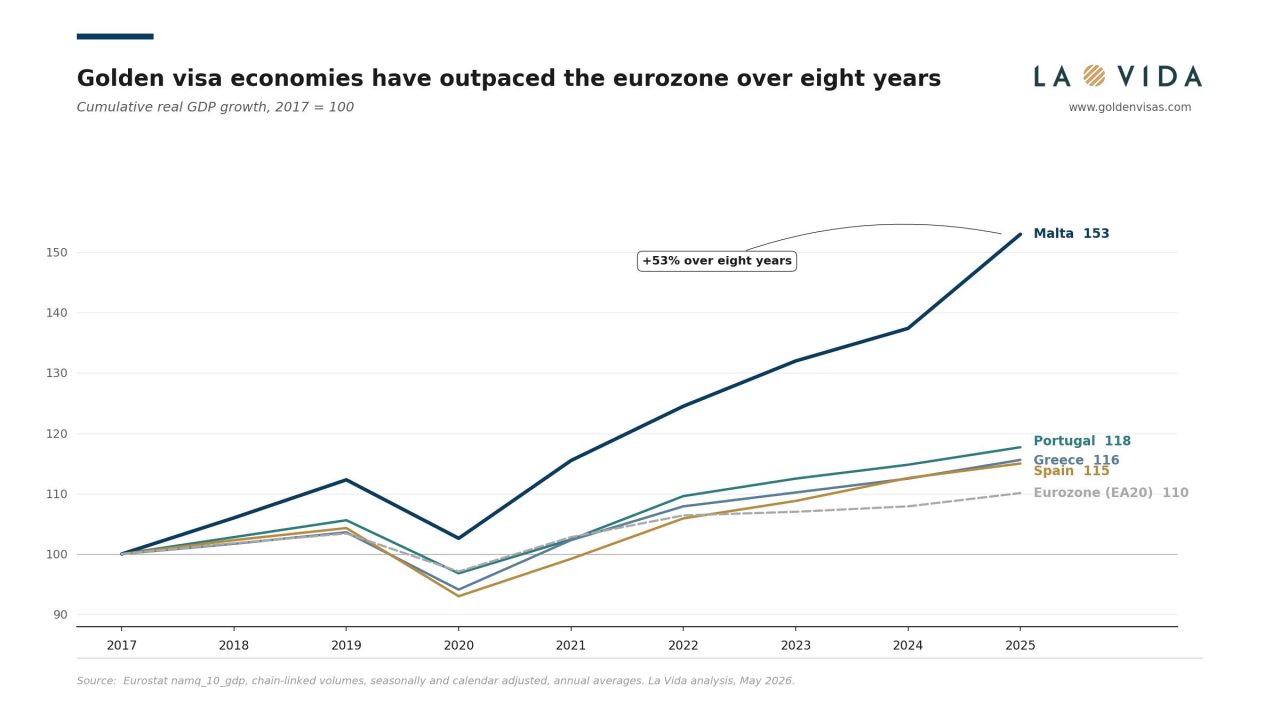
The EU has a growth problem, and it’s no secret. Over the same eight years, the United States grew by 21% in real terms. The world economy grew by 27%. The eurozone managed just 10%. That gap is the single biggest fiscal issue facing the bloc today. Growth is what funds defence, welfare, infrastructure, transition. Without it, the choices in front of European governments narrow sharply.
So here’s a quiet pattern worth noticing. Four economies, all running investment migration programmes throughout the period, all outpacing the bloc. Some by a lot, some by a little, but all four?
Now correlation is not causation. There are many other factors at work — tourism recoveries, EU recovery funds, energy mixes, services exports, the simple arithmetic of bouncing back from a low post-2012 base. But four out of four still says something. If golden visa programmes were entirely incidental to growth, you would expect the distribution of golden visa countries above and below the eurozone average to look more random. The fact that it doesn’t is at least suggestive.
Perhaps the programmes themselves contribute directly through qualifying investment and government fees — though the numbers there are too small to do much of the work. The cumulative direct investment from these programmes sits somewhere in the range of 0.025% to 0.25% of national GDP per year. That moves the needle, but not by ten percentage points over eight years.
Perhaps governments that run these programmes are simply the kind of governments that also run other business-friendly policies, and the growth comes from the wider mix rather than the programme itself. That’s defensible.
But there’s a third reading, and it’s the one that’s consistently overlooked in the political debate. Call it the contributory ongoing wealth effect. The people these programmes attract don’t stop contributing after the qualifying investment. The average client coming through La Vida’s channels has wealth in excess of $2.5 million. That capital doesn’t sit idle. Some of it goes into property. Some takes root in operating businesses, paying salaries and corporation tax for years afterwards. Some goes into the next generation, who study, work and start businesses themselves. The contribution compounds in ways that aggregate statistics struggle to capture but which over an eight-year window begin to show through, with the promise of more to come.
The EU has spent much of the last decade pushing back against investment migration through rhetoric, legislation and, most recently, the European Court of Justice ruling against Malta’s citizenship route. Whether one agrees with that direction or not, the data suggests there may have been a cost. Other European governments are starting to look at this with fresh eyes. The UK has signalled interest in reintroducing an investor route. Italy has been actively expanding its programme.
Investment migration on its own is not the answer to Europe’s growth problem. Nothing on its own is. But it is one of the few policy levers that attracts productive wealth rather than driving it away, and the eight-year data is hard to dismiss.
If half the energy that has gone into restricting these programmes had gone into understanding what works in them, the bloc might be in a better position now to fund the things it says it cares about.
Paul Williams is CEO and Founder of La Vida.
Tags: Insights, Paul Williams
Panama Residency Through A Company: What Investors Want In 2026
Around six of my clients in recent weeks have started their enquiry with the same question about Panama.

Athens Golden Visa: Insights From the La Vida Team
Interest in the Greece Golden Visa has picked up sharply on our website this year, and our sales team has just spent three days in Athens seeing the latest from the market first hand.

Who Decides The Future of Caribbean Citizenship Investment
Following CIS 2026 in Saint Lucia, the debate over Caribbean Citizenship by Investment has moved beyond passports and due diligence. With the European Commission calling for programs to be phased out, and government CBI revenue averaging 6.5% of GDP across the five participating states, the question is who decides what comes next.

GDP Growth in EU lags Golden Visa Economies