
 Portugal
 Antigua & Barbuda
 St Lucia
 Grenada
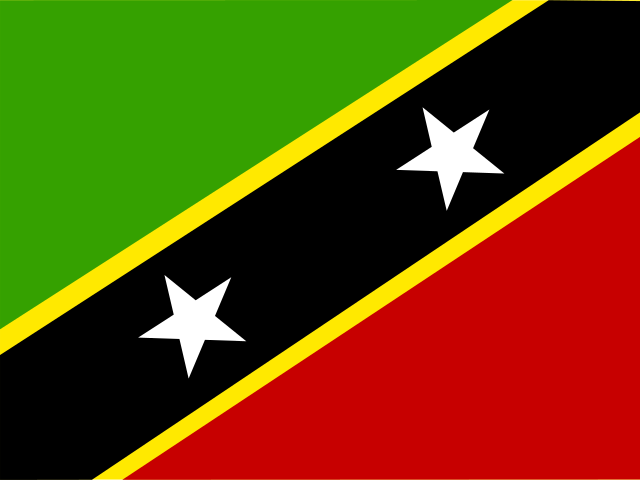 St Kitts
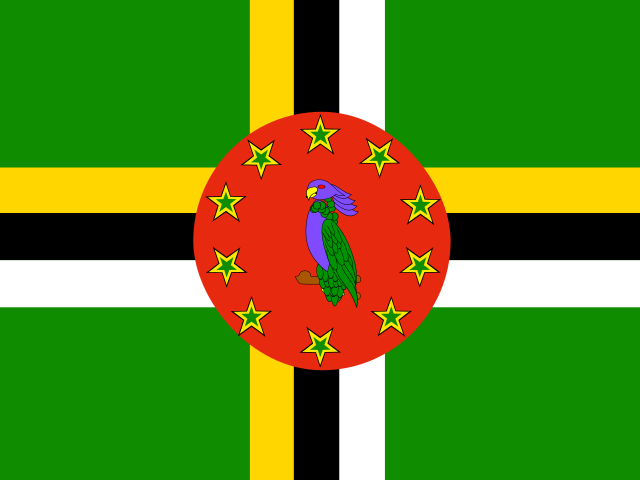 Dominica
 Hungary
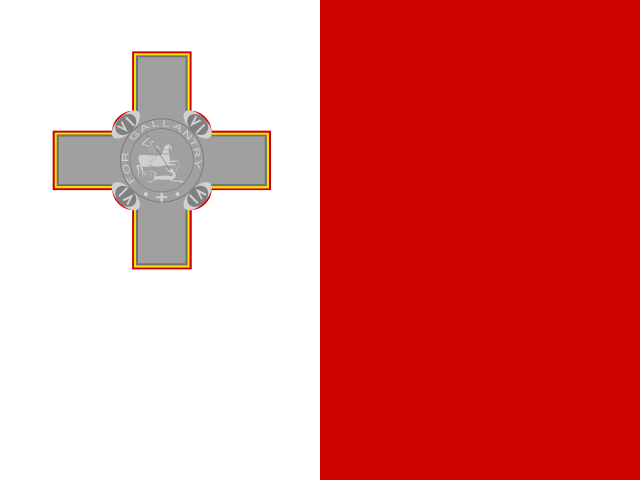 Malta
Malta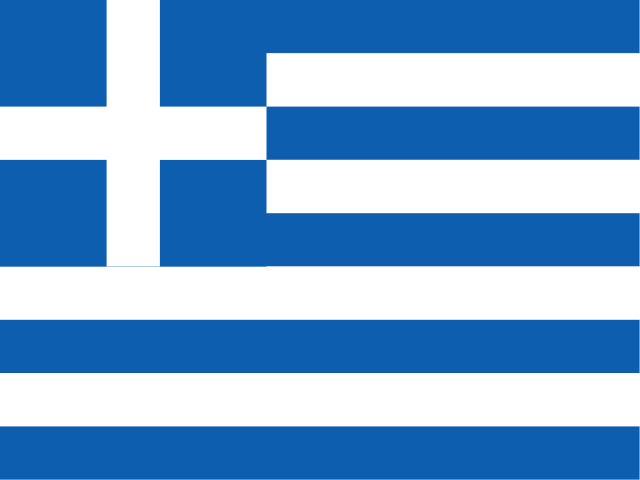 Greece
 Italy
Italy Latvia
 Turkey
 Vanuatu
 Canada
 USA
USA Nauru
Nauru New Zealand
 Panama
 Cyprus
 Sao Tome
 UAE
UAE
St Kitts
Minimum $250,000 Donation
Real Estate Option
Citizenship & Passport
Long Established Program

Data & Methodology
Most passport rankings count how many doors a passport opens. The La Vida Passport Value Index measures what lies behind them — the share of the world’s economy and the share of the world’s travel that a passport unlocks.
The La Vida Passport Value Index is a passport comparison built for one purpose: helping people decide whether a second citizenship is worth the investment, and which programme delivers the most value for their situation. It is published by La Vida Golden Visas, a citizenship and residency-by-investment advisory operating since 2012.
Every passport index is a useful instrument. Counting the number of countries a passport reaches visa-free is a sensible, transparent measure, and we report that count too. But a count answers only one question — how many? — and treats every destination as equal. Access to a major economy and access to a micro-state score the same. For someone choosing where to invest hundreds of thousands of dollars in a second passport, that equivalence hides the very thing they are buying. The La Vida Passport Value Index was built to measure it.
Three dimensions, not one
We assess every passport on three measures. The first is the familiar one. The visitor dimension, and the way we measure what a second passport adds, are what set the La Vida Passport Value Index apart — and why it is the more relevant instrument for a second-citizenship investor.
The count of destinations a passport accesses without a traditional visa. The transparent baseline — and the figure most rankings stop at.
Each accessible destination is weighted by its share of world GDP. This expresses how much of the global economy a passport opens up to its holder. Reaching the United States, Germany, Japan and China is worth far more, commercially, than reaching the same number of smaller economies.
Each accessible destination is weighted by its share of world international visitor arrivals. This captures leisure and tourism value — a different picture from GDP, and one no other major index measures. France, Spain and Italy carry enormous travel weight that their economic size alone would understate.
A passport’s GDP-weighted score and visitor-weighted score are each expressed as a percentage of the world total. A passport opening 60% of world GDP unlocks, by economic value, three-fifths of the planet. Read together, the two percentages give a richer and more honest portrait of a passport’s worth than any single number can.
The investor’s lens
Conventional rankings score a passport in isolation. Our readers already hold a passport; the decision in front of them is whether to add a second one. So the La Vida Passport Value Index is built to answer the question that actually matters to them: what does a second passport gain you, on top of what you already hold?
The tool measures this directly. It takes the passport you hold today, adds a chosen investment passport, and reports the incremental gain — the destinations, the GDP, and the visitor reach the second passport adds that your current passport does not already cover. Two passports that look similar on a standalone ranking can deliver very different gains depending on what the holder starts with. Measuring the marginal value of the investment, rather than the headline rank of the passport, is the heart of what the Index does.
Worked example — why weighting changes the answer
Imagine two passports that each reach 150 destinations. A count-based ranking scores them identically. But suppose the first reaches the United States, Germany, Japan and China, while the second reaches 150 mostly smaller economies. The first opens a far greater share of world GDP — and so delivers far more genuine business utility — even though the headline count is the same.
This is the gap the La Vida Passport Value Index closes. By way of a real anchor: a Grenadian passport, a benchmark Caribbean citizenship-by-investment programme, reaches 157 destinations and opens approximately 59.7% of world GDP — meaning its holders can reach, visa-free, economies representing close to three-fifths of global output.
The access principle
The space between “visa” and “no visa” is crowded — visa on arrival, electronic travel authorisations, eVisas, eTAs. The decision of what counts is where indices quietly differ, yet few state their rule plainly. Ours is simple and built on one principle: does holding this passport confer a genuine advantage at the border? If the passport itself improves your position — turning a closed door into an open or near-open one — we count it as access.
This is the clearest point of difference, so we set it out in full. An eVisa is an online application that can, in principle, be declined. Some indices therefore exclude eVisas entirely; others count only those approved within a few working days. We take a different view, grounded in the investor we serve.
Consider a businessperson holding a passport that requires a full embassy visa for a major destination — weeks of process, an interview, real refusal risk. They acquire a Caribbean citizenship, and for that same destination the route becomes a same-day online form with near-automatic approval. That is not a marginal convenience; it is the difference between practical access and theoretical access. The passport has conferred a real, measurable advantage. An index built to value second passports should count that advantage, and ours does. We count eVisa access as access throughout.
One honest exception applies. A small number of destinations maintain a visa policy on paper — sometimes even an eVisa — while practical access is suspended by active conflict or the collapse of functioning entry infrastructure. Somalia, South Sudan, Libya and Syria are the clearest cases. We score destinations on their official, published visa policy for consistency, but we flag these cases explicitly rather than letting a nominal “open” policy inflate a score. The Index measures the right a passport confers; where that right cannot be exercised in practice, we say so.
The Index counts the destination a passport actually issues from. If you have always lived in your home country, access to it is no benefit to you — and many rankings exclude it for that reason. But our reader is acquiring a new passport. To someone investing in Maltese or Grenadian citizenship, the right to live in and enter that country is among the most valuable things the passport confers. Counting it measures the full universe of destinations the new passport unlocks.
The Index assesses 199 sovereign countries — the 195 widely recognised states plus Taiwan, Kosovo, the Cook Islands and Niue — and 28 territories that maintain their own entry rules and carry their own economic and visitor weight. Territories such as Hong Kong, Macau and the major tourism dependencies materially affect a passport’s real-world reach, so we include them in the weighted totals.
Sources & provenance
Every figure in the Index is built from named, publicly verifiable sources, with a transparent editorial layer on top. This is deliberate: a methodology that cannot be checked cannot be trusted.
Cadence & cross-checks
Visa policy changes constantly, so the La Vida Passport Value Index is refreshed on a quarterly cadence. Visa-access data is rescraped and reviewed each quarter; the GDP and visitor weightings are updated annually as the World Bank and UN Tourism release new figures.
Each refresh is reconciled against world totals before publication. The per-country GDP and visitor figures must sum to the published world denominators — $104.7 trillion and 1.39 billion arrivals — so that every weighted percentage in the Index can be traced back to source. Across the current dataset the average passport reaches 128.7 destinations, opening 43.9% of world GDP and 54.1% of world visitor arrivals; these averages are the benchmark every individual passport is read against.
What the Index is, and is not
The Index is a strategic comparison tool, not travel advice. It reports a passport’s standing under official visa policy at the time of the most recent update. It does not account for temporary or transient restrictions — public-health measures, security closures, reciprocal suspensions — and it should never be used to determine eligibility for a specific journey. For an individual trip, always confirm current requirements with an authoritative source such as IATA Timatic or the destination’s government. Used as intended — to compare passports and weigh the value of a second citizenship — it is, we believe, the most relevant instrument available to the investor.
What is the La Vida Passport Value Index?
It is a passport comparison that weights visa-free access by each destination’s share of world GDP and world visitor arrivals, rather than counting destinations equally. It is published by La Vida Golden Visas and built specifically for people deciding whether to invest in a second citizenship.
How is it different from a ranking based on visa-free country count?
A count treats every destination as equal — access to a major economy scores the same as access to a micro-state. The La Vida Passport Value Index adds two further dimensions: GDP-weighted access (business utility) and visitor-weighted access (travel utility), so it reflects the real-world value of where a passport reaches, not just how many places it reaches.
What does GDP-weighted access mean?
Each destination a passport can reach is weighted by its share of world GDP. The result is expressed as a percentage of the global economy a passport unlocks. A passport opening 60% of world GDP gives its holder visa-free reach into economies representing three-fifths of global output.
Does the Index count eVisas as access?
Yes. We count an eVisa as access because, for the traveller it serves, it is a decisive advantage over a traditional embassy visa — often the difference between a same-day online form and a weeks-long consular process. We make one qualification: in active conflict zones where access is only nominal, we flag the destination rather than let a paper policy inflate the score.
Where does the visa data come from?
Visa-access data is built from the openly licensed Wikipedia “Visa requirements” dataset, which cites IATA Timatic and government sources inline, with a La Vida editorial review applied on top for the citizenship-by-investment programmes our clients consider. Economic weighting uses World Bank GDP (2023); travel weighting uses UN Tourism international arrivals (2023).
How often is the Index updated?
Visa-access data is refreshed quarterly. The GDP and visitor weightings are updated annually as new World Bank and UN Tourism figures are released. Each refresh is reconciled to world totals before publication.
Why does the Index count the holder’s own country?
Because our reader is acquiring a new passport. The right to enter and live in the country of a newly acquired citizenship is one of its most valuable features, so the Index includes it to measure the full reach the new passport unlocks.
Can I rely on the Index to plan a specific trip?
No. The Index is a strategic comparison tool reflecting official visa policy at the last update. It does not capture temporary restrictions and should not be used to determine entry for an individual journey. Always confirm current requirements with an authoritative source such as IATA Timatic before travelling.
See what a second citizenship would add to the passport you already hold — weighted by world GDP and global travel.
Get your free passport reportIndex data current as of June 2026 · Reviewed quarterly
The La Vida Passport Value Index is published by La Vida Golden Visas for informational purposes. It reflects official visa policy at the time of the most recent update and is not a guarantee of entry to any destination. For requirements applying to a specific journey, consult an authoritative source such as IATA Timatic or the relevant government. Data sources: Wikipedia “Visa requirements” pages (CC BY-SA), World Bank (GDP, 2023), UN Tourism (international arrivals, 2023).
St Kitts
Minimum $250,000 Donation
Real Estate Option
Citizenship & Passport
Long Established Program

Antigua & Barbuda
Minimum $230,000 Donation
Citizenship & Passport
Visa Free Travel 186 destinations
EU Schengen Zone & UK

Malta
From €99,000 + costs
Investment and Donation
Permanent Residency + Citizenship
Full Family Options